Tuesday, 5 November 2013

A Walk Around Edinburgh: Part Two

Old Tolbooth Wynd. Built in 1591 it is named after the Auld Tolbooth. 
Canongate Kirk. The church was founded in 1688 and completed three years later. 

There are some pretty impressive headstones in the graveyard. 
Looking across at Calton Hill from Canongate Kirk. 
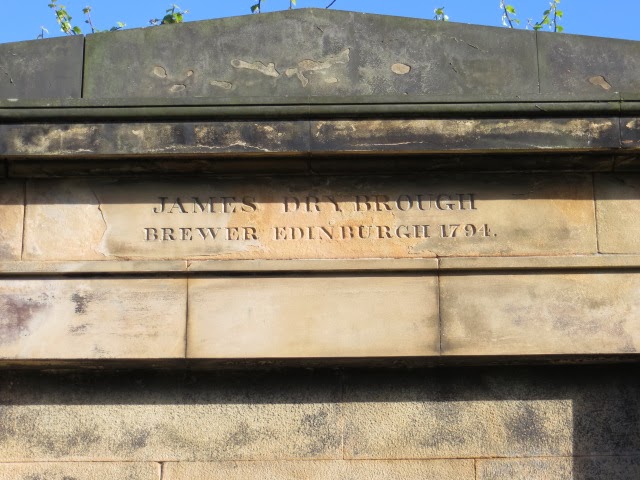
One of the 'residents' in the graveyard is James Drybrough, of the well known brewing family. 

The resting place  of Robert Fergusson, with plaque as seen in the previous image. 
This plaque is on the side of Canongate Kirk and is a memorial to those who lost their lives in the Second World War and were employees of the brewer, William Younger. 
Entrance to the Canongate Kirk.

Statue of Scottish poet Robert Fergusson (5th September 1750 - 16th October 1774), which stands outside the Kirk. 
Canongate Mercat Cross, which signified a market site, was originally in the middle of the street, but was moved in 1737 to the outside of the Tolbooth building in Canongate. It was moved again in 1953 to its present location. 
Close up of the plaque on the Cross. 
Dunbar's Close Garden is a real oasis of peace and quiet, yet only yards away from Canongate and probably missed by many tourists, and maybe a few locals as well. 
A view of the garden.
The gardens are certainly well kept. They are laid out in the style of the 17th century and were donated to Edinburgh City Council in 1978.
A solitary cornflower.
Dunbar Close is named after David Dunbar who owned buildings either side of it in 1773. 
We sat in the gardens for a while, before continuing our walk along Canongate. 
Panmure Close named after the Earl of Panmure. 
Well what can one say about a shop called this?!!
Almost at the foot of Canongate and clsoe to Holyrood Palace.

(Tomorrow we continue with Part Three of our walk).

Monday, 4 November 2013

A Walk Around Edinburgh: Part One

This week is 'Edinburgh Week.' At least it is on North West Images this week. A day trip to Scotland's capital city last Friday resulted in numerous images being taken, some of which will appear here today and during the rest of the week. It will follow a walk that we did around mainly the old part of the city, namely the Royal Mile and Canongate. As soon as you step outside of Waverley station and head toward Princes Street Gardens, you hear the skirl of pipes, and needless to say the piper is a popular tourist attraction for photographs as above. 
The Scott Monument is in Princes Street, overlooking the gardens. It is a monument to Scottish author Sir Walter Scott and is just over 200 feet high. It was completed in 1844.  Note the blue sky, for we were really lucky as far as the weather was concerned, although there was a chill in the air. 
Looking across Princes Street Gardens with Edinburgh Castle on the sky line. 
A closer look at the Castle.
The upper level of Princes Street Gardens with the well known Princes Street on the left. 

The gorgeous Autumn colours of Princes Street Gardens. 
A William Wallace exhibition was being staged here. Wallace, who died in August 1305, was a Scottish landowner and one of the main leaders during the Wars of Scottish Independence, fighting the English.
Fleshmarket Close was the location of one of Ian Rankin's 'Inspector Rebus' novels. It leads up to Cockburn Street and the old part of the city. 
Mid way up the flight of steps, and conveniently, is the Halfway House, which is said to be Edinburgh's smallest pub. A regular port of call when we are in Edinburgh, and the first refreshment stop of the day!
Suitably refreshed, it was on up the steps of Fleshmarket Close. This view is from the Cockburn Street end of the Close looking down towards Waverley station. Time to stop and take a deep breath after the climb!
The old part of the city has numerous alleys, or Close as they are called. This one is Carrubber's Close. The origin of the name of the Close is unknown although it is possibly linked to Sir William de Carriberris, a merchant and magistrate who lived nearby in the 1450s. 
The decorative entrance to Morrison's Close. Named after a merchant from the 1750s, John Morrison, who owned property nearby. 
Bailie Fyfe's Close. Imagine going down here in the dark! It is named after Gilbert Fyfe from the late 1600s, a merchant and magistrate (also known as a Bailie). 
Rabbie Burns restaurant and whisky bar.  
Paisley Close leads to the Celtic Craft Centre. The Close is named after Henry Paisley who bought the land in 1711. 
Chalmers' Close is named after a former belt maker, Patrick Chalmer. 
Walking down towards Canongate, an inevitable kiltmakers shop. 
Baron Maule's Close. Henry Maule bought a property at the end of the Close in 1711. 
A glimpse of Carlton Hill in the distance, with the approaches to Waverley station below. The castellated structure is the former Governor's House of the Old Calton Gaol.
Some wholesome traditional Scottish food here. Not sure about the Puffin Poo though!
Estabished in 1949, Maddocks and Dick manufacture ties and scarves. 
Simply Scottish and Cadenhead's Whisky Shop on Canongate. 
This colourful shop  is where Celtic crafts and knitwear can be purchased.

(We continue our walk tomorrow, down the hill of Canongate, toward Holyrood Palace).

Sunday, 3 November 2013

The Food Signs of Ambleside!

The businesses in the town of Ambleside have hit on a clever marketing ploy. Open lots of tempting eating establishments where visitors can spend their money, enjoy the food and pile on the weight. Then visit one of the countless outdoor shops, get them to spend their money again on hiking gear, so they can walk off their excess weight with a trek across the Fells. Brilliant isn't it?  Here are just a very small selection of signs advertising eating establishments in Ambleside. There are many, many more!
I would have to give this on a miss, as I don't like heights.
Nor do I eat sea food of any sort either. 
That's more like it. Tasty fudge. Mmm.

Curry. Another of my favourites, as long as it isn't chicken. 


The final image of this particular set. Think I'll have to go and get something to eat. 

Saturday, 2 November 2013

Autumn In Winckley Square

Winckley Square is just a few minutes walk from the bustling city centre of Preston, yet it is so peaceful here. In fact you could almost be out in the country somewhere. The Autumn colours at this time of the year are stunning. 

There were fallen leaves everywhere. 


The square is surrounded by Georgian built residences, many now used as offices. 

A magnificent Weeping Willow tree. 

Squirrels were seen darting all over the place. They are extremely difficult to photograph! (Pic - Mooncat755)


The statue of Sir Robert Peel stands in Winckley Square. It was erected in 1852, two years after his death. Peel was twice Prime Minister, December 1834 to April 1935, and August 1841 to June 1846. Whilst One Secretary, Peel helped create the modern concept of the police force, leading to officers being known as 'bobbies' (in England) and 'peelers' (in Northern Ireland).
One of the entrances to the Square.